Premium Concrete Driveways, Aprons & RV Pads
Upgrade your home’s curb appeal and practicality with a concrete driveway or RV pad—built for longevity, engineered for performance, and crafted with expertise.
Rock-solid Driveways for Lasting Value
Best for: Homeowners seeking a strong, attractive, and long-lasting solution for driveways, parking extensions, and parking pads for RVs, boats, or extra vehicles.
A concrete driveway or RV pad is more than just a place to park—it’s an improvement to your property’s value, function, and appearance. At California Hardscapes, we believe a driveway or pad should be attractive enough to impress, yet tough enough to last through harsher local weather and the demands of everyday use. The right installation, with a properly engineered base and reinforcement, is essential for keeping surfaces crack-free and reliable for years to come.
Our philosophy is simple: We don’t compete on being the cheapest. We compete on quality, integrity, and results that exceed expectations. Every driveway, apron, or RV pad is built with the same care and attention to detail we would demand for our own homes—no corners cut, no shortcuts, and nothing left to chance. This matters even more in Northern California, where changing temperatures, varied soils, and strict city and HOA requirements call for true expertise.
Whether you’re looking to replace a worn driveway, add a parking pad for an RV or boat, expand with an extra parking spot, or refresh your home’s entry with a new apron, understanding the essentials is key. Here, you’ll find detailed information on construction options, technical choices, typical build quality and process, and things to consider before starting your project in Rocklin, Roseville, Granite Bay, Folsom, Auburn, and the surrounding foothill communities.
Design & Construction Options
Standard Concrete Finish
The classic broom or medium-brush finish provides safe traction and a timeless look for driveways and RV pads. It’s the most economical surface, easy to maintain, and shows less tire wear than smoother finishes. Color can be added for a subtle custom touch.
Exposed Aggregate Borders
For added curb appeal, exposed aggregate edges or bands feature stones revealed at the surface, contrasting with the main slab. This decorative option gives your entry character and pairs well with all landscape styles, from modern to traditional.
Stamped or Colored Concrete
Stamped patterns and integral or surface-applied colors can replicate the look of stone, brick, or pavers with the strength and performance of concrete. Choose from squared or curving borders, textured finishes, and a wide range of earth-tone color blends.
Driveway Aprons & Extensions
Aprons connect the main driveway to the street and are regulated by local standards. Extensions—such as side parking strips or widened driveways—ensure seamless transitions, additional parking, and comply with setbacks and approach slopes as required by cities or HOAs.
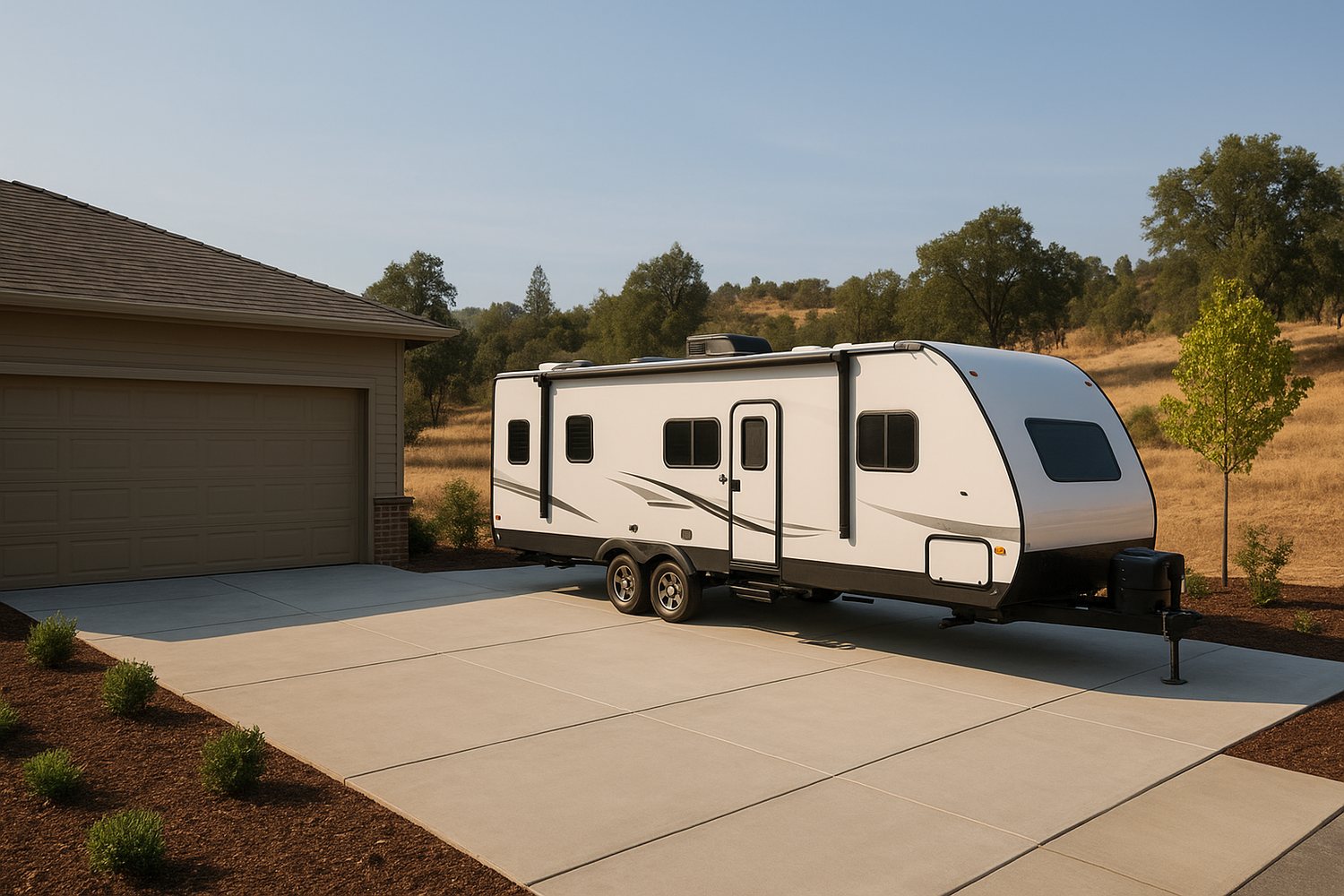
Concrete RV or Boat Pads
RV and boat pads are built thicker and with heavier reinforcement than standard driveways: often 5–6 inches thick, sometimes thicker for large Class A vehicles. Their layout can be tailored to existing side yards, with city or HOA review in some cases.
Decorative Edges & Expansion Joints
From rounded bullnose borders to straight saw-cut or tooled joints, edge and joint designs impact both appearance and long-term durability. Proper planning manages cracks and defines clean visual lines, helping your driveway age gracefully.
How a Concrete Driveway or RV Pad Gets Built—The Right Way
Quality starts beneath the surface. Our expert-managed crews know that a driveway or pad’s strength is set by its foundation, reinforcement, finish, and the attention to the details that prevent common failures. We build each slab to stand up to Rocklin and the Sierra Foothills’ unique conditions—and we don’t skip steps.
- Subgrade Preparation: We strip organic material and loose soil, then compact the native earth or, if needed, import structural fill. Proper pitch is set to support drainage away from your home and prevent pooling.
- Base Installation: Crushed rock or class II aggregate base (usually 4”–6”) is added and compacted, especially critical in clay or decomposed granite soils for stability and drainage.
- Form Setting: Heavy-duty forms are installed to establish shape, edges, and proper slope—checked for dimensions, setbacks, apron alignment, and vehicle turning clearance. Laser level or string lines ensure accuracy.
- Reinforcement Placement: Steel rebar grid (typically #3 or #4), sometimes with welded wire mesh, is spaced to meet load needs—closer for RV or heavy vehicle areas. Chairs or dobies hold reinforcement up within the slab.
- Joint Layout: Expansion joints and control joints are planned in advance and installed (tooled, inserted, or saw-cut) to direct natural cracking to safe, straight lines and avoid random failures. Location and spacing are based on slab size and shape.
- Concrete Pouring & Finishing: Ready-mix concrete is poured at specified thickness (minimum 4” for cars, 5–6” or more for RVs) and air-entrained when needed for freeze durability. Surface is floated, finished (broom, stamped, or exposed), and edges are detailed.
- Curing & Sealing: Curing is strictly controlled—curing compound, blankets, or light water mist as weather dictates—to avoid cracking or surface defects. Once cured, a penetrating or topical sealer is applied for stain and moisture resistance.

Pros & Cons of Concrete Driveways and RV Pads
Strengths
- Durability: Properly built concrete driveways and pads can easily last 30–40 years or more—especially with good drainage and reinforcement.
- Low Maintenance: Unlike asphalt, concrete doesn’t require frequent resealing or patching, and resists rutting and tire gouging.
- Curb Appeal: Clean lines, border designs, and decorative options enhance property value and look fresh for decades.
- Strength: When poured thick with reinforcement, concrete outperforms asphalt and basic gravel for heavy vehicles like RVs or boats.
- Resistance: Stands up well to UV, chemical spills, oil leaks, and local temperature swings from hot summers to winter freezes.
Trade-offs
- Cost: Concrete is a higher up-front investment than asphalt or gravel, but pays off in long-term lifespan and lower ongoing expenses.
- Installation Time: Local city or HOA reviews, permit waits, and cure times mean a typical project can’t be rushed—good work takes patience.
- Repairs: Large cracks or settlement rarely blend seamlessly when patched. Major issues may require partial replacement rather than small spot fixes.
- Surface Sensitivity: Improper early driving, winter salt, or studded tires can scar or pit the surface if not managed, especially in first months after install.
Concrete Driveways & RV Pads: What Affects Cost?
Concrete driveways and pads represent a long-term investment in your home’s function and value, but pricing can vary depending on a range of technical and site-specific factors. We always recommend that homeowners understand what drives the investment, what extras (like base, thickness, or special reinforcement) are worth considering, and the limits of what ‘cheap’ concrete can deliver. At California Hardscapes, we build every project to the highest standards to ensure a worry-free result that lasts.
- Driveway or Pad Size: Both total square footage and complexity (curves, parking wings, tapers) affect labor and materials.
- Thickness & Reinforcement: Extra depth (for RVs or heavy vehicles) and heavy rebar or mesh add strength and price—but often pay back over decades.
- Site Preparation Needs: Sloped lots, clay soils, old roots, demolition or removal of failed existing surfaces, access challenges, and drainage corrections add difficulty.
- Finish Details: Decorative patterns, colored surfaces, exposed aggregate, and special borders increase labor and material costs compared to a standard broom finish.
- City, County, or HOA Requirements: Permitting, inspections, and approach/apron construction (often to city standards) sometimes add cost and extend timelines.
- Access & Logistics: Limited machine access, confined lots, need for pumps, or difficult concrete delivery locations can increase bid pricing.
Concrete Driveway & Pad Care—What to Expect
Routine maintenance is straightforward: Keep surfaces clean from leaves, dirt, and de-icing salts; promptly rinse oil or chemical spills; pull weeds from joints; and avoid using metal-edged snow shovels. In areas with hard water, occasional calcium cleaning helps prevent stains or discoloration near hose bibs or irrigation overspray. Address drainage problems promptly—standing water is concrete’s enemy.
A quality sealer should typically be reapplied every 2–5 years, depending on use and exposure. Properly built, driveways and pads in our region have a 30–40 year average lifespan, but longevity depends on traffic, upkeep, underlying soils, thickness, reinforcement, drainage, and root intrusion. Pay special attention to overhanging oak trees whose roots may heave slabs over time—root barriers can be helpful at installation.
Compare other options

Concrete patios
Explore expert advice on concrete patios in Rocklin: layout, finishes, durability, costs, design tips and care. Make the right choice for your outdoor space.
Explore →
Concrete repair, sealing and replacement
Crack repair, joint sealing, spall and scaling repair, sealing and resealing, slab lifting considerations, and when to remove and replace.
Explore →
Colored (integral color) concrete
Explore integrally colored concrete by California Hardscapes Rocklin—pigment choices, color charts, matching, care & trade-offs for Placer & Sacramento homes.
Explore →Frequently Asked Questions About Concrete Driveways & RV Pads
How thick should my concrete driveway or RV pad be?
For most standard passenger vehicles, a 4-inch slab (with rebar) meets code. For RVs, boats, or heavy trucks, 5-6 inches (or even more where required by local loading) is ideal. The slab thickness should match the heaviest loads you plan to park. Thicker sections also offer extra durability in areas with poor subsoil or likely root intrusion.
Do I need permits or HOA approval for a new driveway or pad?
Nearly all cities in this region—Rocklin, Roseville, Folsom, Auburn, Granite Bay, etc.—require review and permits for new driveways, aprons that access public streets, and most RV or boat pads. If your home is part of an HOA, their design approval is often needed as well. Requirements can vary, so always check with your local building department or HOA before beginning construction.
What type of reinforcement is best for my driveway or RV pad?
A grid of steel rebar (usually #3 or #4 bars, spaced per design load) embedded in the slab, supported on concrete chairs, is the gold standard for driveways and essential for RV pads. Welded wire mesh is sometimes added for shrinkage control, but rebar carries the structural load. For unusually wide, long, or heavily loaded areas, design details can be customized.
How are cracks in concrete managed or prevented?
All concrete will eventually crack, but correct placement of control and expansion joints ensures that any movement or shrinkage happens along straight, planned lines. A properly compacted base, adequate thickness, use of reinforcement, and careful curing each play critical roles in avoiding random or ugly cracks.
Will weather in my area—summer heat or winter cold—damage my driveway or pad?
Concrete built for Northern California’s hot summers and occasional winter freezes must be air-entrained (to resist freeze-thaw damage), well cured, and sealed. Surface sealers help protect against stains, water intrusion, and mild freeze cracking—especially useful if your lot is exposed to both sun and winter shade.
How soon can I drive or park on new concrete?
After pouring, light foot traffic is usually allowed within 24–48 hours, but vehicles (even light cars) should stay off for at least 7 days—longer for heavy vehicles or thick RV pads. Full strength develops over about 28 days. Early loading can harm the slab permanently, leaving tire marks or even causing cracks.
What are the maintenance requirements to keep my concrete looking good?
Keep your driveway or pad clean: sweep regularly, remove oil or fertilizer spills promptly, trim back grass or roots from joints, and avoid using harsh salts for ice. Reapply a good-quality sealer every couple of years, and watch drainage to avoid puddling. These steps will keep surfaces cleaner and help maximize lifespan.
How does concrete compare to asphalt or pavers for driveways?
Concrete driveways last much longer than most asphalt, resist rutting, and require less frequent repair. Compared to pavers, concrete can be less expensive and offers a clean, monolithic look, though pavers allow for easy individual repairs or pattern changes. Each option has its pros and trade-offs depending on budget, look, and site needs.
Ready to Start? Get Expert Input on Your Driveway or Pad
Contact Marty and our California Hardscapes team by email at sales@californiahardscapes.com with your address, a short description of your needs, and photos if available. We’ll give straight answers, honest recommendations, and help you make an informed decision.