Stone & Stucco Veneer Retaining Walls in Placer, Sacramento & El Dorado Counties
If you want a retaining wall that’s as attractive as it is durable, stone and stucco veneer finishes are among the most versatile options. California Hardscapes builds these walls with deep attention to construction quality and custom detail.
Why Consider a Stone or Stucco Veneer Retaining Wall?
Best for: Perfect for homeowners wanting structural support paired with a custom look that matches their home and landscaping.
Retaining walls aren’t just for holding soil in place. When finished with stone or stucco veneer, they become a defining feature of your outdoor space—one that can boost curb appeal and genuinely look built-in, not tacked-on. If you’re looking for both form and function, this approach delivers both. The key is building on a solid structural core and finishing with premium materials, not surface shortcuts.
Most stone and stucco veneer walls start with an engineered concrete or block (CMU) core, designed to withstand the lateral soil pressure—even on slopes or in clay-rich California soils. This inner structure does all the heavy lifting. The veneer—whether that’s hand-selected ledgestone, cut flagstone, or a custom-colored stucco—adds character, depth, and matches architectural styles from California modern to Mediterranean.
We believe your retaining wall should be built as if it were framing our own home. Our philosophy: We don’t compete on being the cheapest. Instead, we compete on quality, integrity, and results that exceed expectations. This page details exactly how we design and build these walls, practical options, real maintenance realities, cost considerations, and the limitations every homeowner should know before choosing this investment for their property.

Stone & Stucco Retaining Wall Veneer Options
Natural Ledgestone Veneer
Ledgestone provides a rugged, layered appearance with depth, color variation, and shadow lines that complement both traditional and modern homes. Available in a range of local and imported stones, from warm earth tones to cool grays, it’s one of the most popular veneer choices for premium visual impact and durability.
Cultured (Manufactured) Stone Veneer
Manufactured stone veneer offers consistent color and shape, often at a lower material cost than natural stone. Modern products look convincingly real and come in many styles—from stacked slate to river rock. These are lightweight panels, ideal where the wall build can’t support the weight of natural stone, or for budget-conscious upgrades.
Traditional Stucco Finish
Stucco-over-concrete delivers a clean, timeless look and matches most California homes, especially those with Mediterranean, Spanish or modern architectural styles. Stucco can be custom colored and textured—smooth, sand finish, or rough—giving flexibility to suit your home’s facade. It’s lower maintenance than stone and can be recoated to refresh over time.
Stone Caps
A stone or cast concrete cap not only finishes the look, but helps shed water away from the veneer below. Caps can have chiseled, bullnose, or squared edges, and be set flush or with an overhang. Caps are available in limestone, sandstone, bluestone, or precast concrete to coordinate with the house and other hardscapes.
Custom Colors & Mortar Joints
Veneer can be installed with tight, dry-stacked joints for a modern look, or with contrasting, recessed, or flush mortar joints for a classic style. Custom mortar colors and finishes help unify the wall with your home’s palette and other landscape features, bringing a tailored, ‘built with intent’ feel.
Integrated Lighting & Features
Walls can be built with low-voltage LED step lights or accent fixtures embedded in the veneer for safety and nighttime drama. Integrated planters, mailbox enclosures, or bench seating can also be added in matching stone or stucco to create seamless, functional hardscape elements.
How a True Quality Veneer Retaining Wall Is Built
A veneer retaining wall is only as good as the construction beneath the surface. California Hardscapes follows industry-leading steps and never cuts corners. The wall is engineered to last in our demanding Northern California soils, and finished to look great for decades. Here’s how we do it:
- 1. Subgrade Preparation: The area is excavated to proper depth for both wall stability and base material. Weak soils (like clay pockets or fill) are removed and replaced as needed.
- 2. Base Installation: A compacted gravel base—typically 4–8" deep—is installed beneath the wall. This provides drainage and eliminates settling or heaving, especially important in our clay and decomposed granite soils.
- 3. Formwork and Footing: Concrete forms are set and reinforced steel (rebar) installed per engineered specs, then a reinforced concrete footing is poured and allowed to cure for stability and code compliance.
- 4. Structural Core Construction: Concrete block (CMU) or poured-in-place concrete forms the structural wall. This supports all lateral pressure from soil and holds up the veneer—never rely on veneer alone for structure.
- 5. Drainage & Weep Holes: Behind the wall, a gravel drainage zone and drain pipe are installed, with weep holes at the base to relieve water pressure behind the wall and prevent moisture buildup behind the veneer.
- 6. Veneer & Cap Installation: Stone or stucco finish is installed on the front, with careful attention to layout, joint spacing, and tie-in to capstones. Caps are set with waterproof adhesives or mortar to shed water and protect the wall top.
- 7. Final Detailing & Cleanup: Mortar joints and stucco are touched up, all surfaces cleaned, site graded and left tidy. Sealing (when called for) is applied only after full cure to protect from staining and moisture intrusion.

Pros & Cons: The Real Trade-Offs
Strengths
- Exceptional curb appeal and versatility—customizable to truly match your home and landscape.
- Won’t rot, warp, or attract termites—unlike wood walls.
- Long service life when built correctly, especially with proper drainage and structural core.
- High resistance to sun, rain, frost, and heat common in our region.
- Can increase property value and blend with other masonry features like steps and patios.
Trade-offs
- Higher initial cost than timber or plain block walls, especially with quality materials.
- Installation is slow and labor-intensive—true craftsmanship takes time.
- Veneer damage is harder to repair than repainting or replacing a wood wall.
- Requires periodic care: resealing, cleaning weep holes, and occasional mortar touch-ups.
Cost Factors for Stone & Stucco Veneer Walls
The cost of a custom stone or stucco veneer retaining wall depends on much more than the square footage alone. While these walls are an investment, their longevity, aesthetics, and the substantial materials and professional labor required are reflected in the price. We build as if for our own homes: doing it right means paying fair for skilled work with no shortcuts.
- Length, height, and thickness of the wall—taller walls require deeper footings, more reinforcement, and more finish material.
- Type of structural core—poured concrete often runs higher than block, especially for longer runs or curves.
- Stone or stucco finish—natural stone costs more than manufactured; complex patterns, custom cuts, or premium colors increase labor and material costs.
- Site access and preparation—difficult access, slope, or poor soils require more excavation, base work, and labor.
- Drainage system complexity—integrated drains, gravel zones, and weep holes add cost but are critical for performance.
- Additional features—caps, lighting, integrated steps, or planters increase material and installation time.
Care, Maintenance & Expected Lifespan
A well-built stone or stucco veneer retaining wall is low maintenance, but not no-maintenance. Inspect the wall each spring and fall for cracked or missing mortar, loose veneer pieces, or clogged weep holes. Gently wash dirt and stains off the veneer (avoid harsh pressure washing). Sealing natural stone every 2–4 years helps resist efflorescence, stains, and freeze-thaw cycles—ask about maintenance schedules for your specific veneer type.
Typical lifespan for a properly constructed veneer wall is decades—often sixty years or more. However, longevity depends on water management, keeping plants or irrigation from soaking the wall, avoiding harsh impacts, and addressing minor damage (like shifting caps or stucco hairline cracks) before it spreads. In our local climate, most repairs stem from water intrusion or tree roots, not age. Occasional resealing, repointing, and drain cleaning keep your investment performing and looking its best.
Compare other options

Terraced walls for sloped yards
Learn about terraced retaining walls for sloped yards in Rocklin & surrounding areas. Expert tips on design, spacing, drainage, steps, and engineering.
Explore →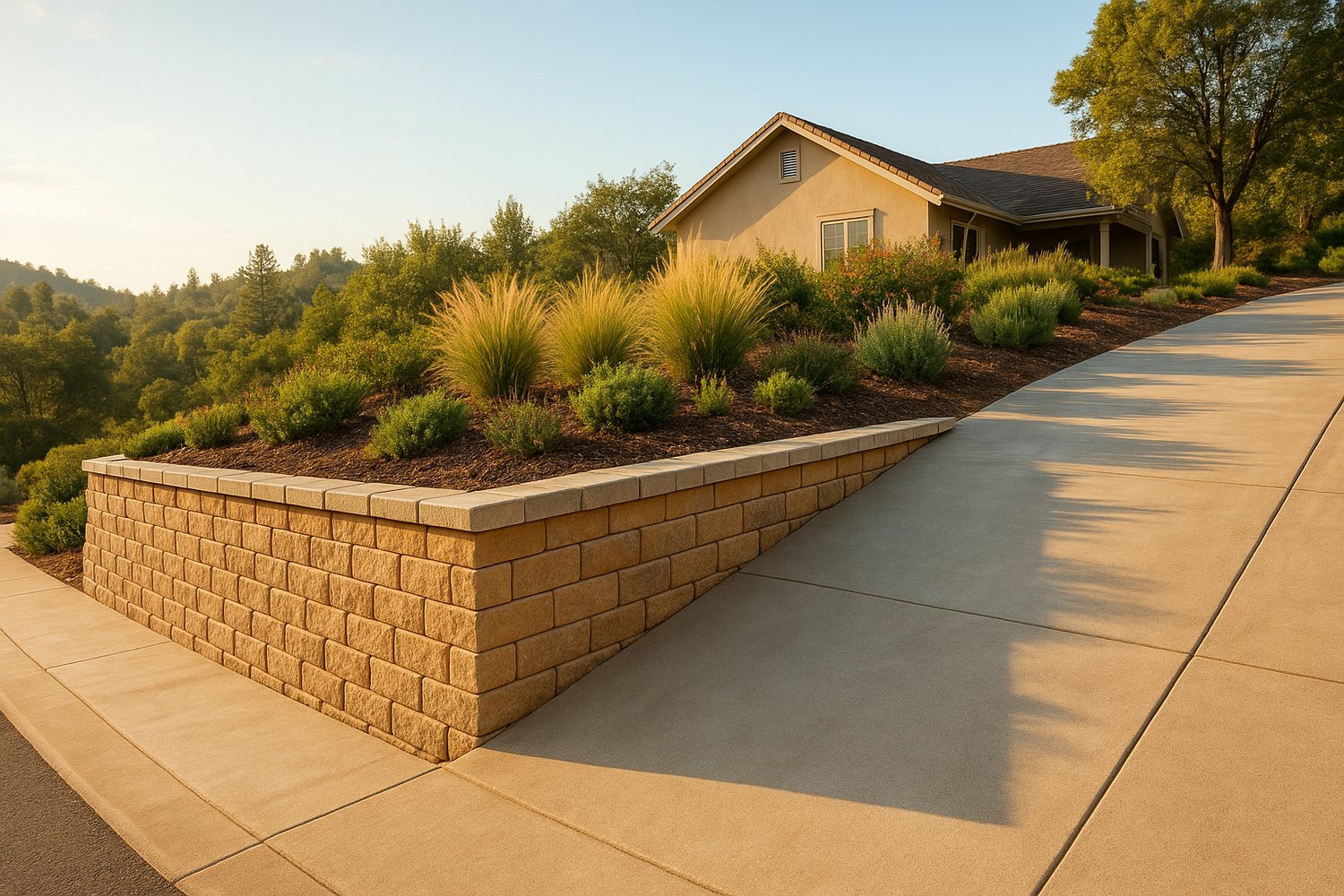
Driveway and front yard walls
Retaining walls along driveways, front yards and street frontage.
Explore →
Natural stacked stone walls
Explore dry-stack natural stacked stone retaining walls. Pros, cons, build steps, care tips, and honest guidance for Rocklin and surrounding areas.
Explore →Frequently Asked Questions
How long does a stone or stucco veneer retaining wall typically last?
A professionally built veneer wall should last several decades, often exceeding sixty years with proper maintenance. Structural failure is rare if the core is engineered for the site’s soils and slopes, water is managed with drains and weep holes, and minor issues (like broken caps or mortar cracks) are addressed promptly. Moisture management and regular care have a bigger impact on lifespan than veneer type alone.
What is the purpose of weep holes in veneer retaining walls?
Weep holes at the base of a veneer wall let water escape from behind the wall, reducing hydrostatic pressure and preventing moisture buildup that could compromise both structure and veneer. They’re especially crucial in clay soils and with hardscape patios or lawns directly upslope. Combined with a gravel drainage zone and drain pipe, weep holes help ensure the wall stays dry and stands the test of time.
Can you match my house’s stucco or stone exactly?
We aim to match existing stucco color and texture, or select stone that complements your home. For stucco, we custom blend colors and sample finish textures to align with your existing walls. With natural stone, perfect matches are sometimes limited by availability or natural variation—but we closely coordinate choices for the best visual result. Manufactured veneer can be ordered in specific color blends to closely match older installations.
How thick is a typical stone or stucco veneer?
Stone veneer used for walls is usually 3/4" to 2" thick, applied directly to the structural core with a high-strength mortar. Stucco is generally built up in two or three coats totaling about 3/4" to 1" thick. The actual wall thickness (including structural core and veneer) varies depending on wall type and code, but veneer never provides the structural strength—only the finish.
Do these walls need permits or engineering?
Generally, any retaining wall over 3 or 4 feet tall, or supporting a driveway or structure, requires a permit and engineering in our local cities and counties. Exact rules vary by address, wall height, and use. For all but the smallest landscape walls, we recommend checking with your HOA and building department early. If you already have engineered plans, bring them to your consultation.
How do you handle drainage behind the wall?
We install a gravel-filled trench and perforated drain pipe behind the structural wall, leading water safely away from soil contact points. Weep holes at the wall face let water exit instead of building up behind the veneer. Proper slope and backfill are critical to keep hydrostatic pressure in check and prevent frost damage and efflorescence. Adequate drainage is always worth the investment for long-term performance.
Can you include steps or planters in a veneer wall?
Yes—steps, planters, benches, or mailbox piers can be seamlessly incorporated into structural concrete or block walls, and finished to match in stone or stucco. These features must be planned at the start, so the footing, core, veneer, and cap align and avoid future settlement or leaks. This approach creates a cohesive, custom hardscape—especially helpful in tight entryways or sloped yards.
Are veneer retaining walls resistant to earthquakes?
A properly engineered and built concrete or block core, with adequate footing, reinforcement, and flexible drainage, performs very well in our region’s moderate seismic events. The veneer—whether stone or stucco—should be securely tied to the core, but it’s the structural component that offers stability. Minor cosmetic cracks in stucco can sometimes develop in a quake but usually don’t affect performance if the wall is soundly built.
Start Your Stone or Stucco Veneer Wall Consultation
Email sales@californiahardscapes.com with your address, a short description of your space, and a few photos. We’ll review your needs and provide real, practical guidance for the next steps.