Smart Lighting Controls for Outdoor Spaces
Take command of your home’s landscape and pool lighting with reliable, automated smart controls built for California yards.
Why Consider Smart Lighting Controls Outdoors?
Best for: Homeowners seeking control, efficiency, and creativity in outdoor lighting—from routine safety to seamless entertaining.
The right outdoor lighting system is about more than just fixtures—it’s about living comfortably and safely after dark, with the power to set the perfect mood on demand. In growing suburban communities like Rocklin, Roseville, Granite Bay, Folsom, and Auburn, we see homeowners looking for lighting solutions that are both practical and flexible. Enter smart lighting controls: an investment that sits at the crossroads of safety, sophistication, and sustainable living.
Smart outdoor lighting controls let you schedule, group, and adjust your landscape lights with just a tap on your phone, a voice command, or an automated schedule that adapts throughout the seasons. Beyond convenience, these systems maximize energy efficiency while keeping the focus on what matters most—your family’s comfort and your home’s curb appeal. Whether you’re hosting a backyard BBQ, illuminating a path for nighttime safety, or synchronizing your pool and patio lighting, smart controls put you in command.
Installed correctly, integrated outdoor lighting controls act as both watchful guardian and subtle backdrop. From timers and photocells to advanced astronomical clocks and intuitive apps, the choices today go far beyond the basic switch. Is all this technology right for every homeowner? Not always. We believe upgrades like smart controls are worth considering when quality, reliability, and creative flexibility are more important to you than lowest price. At California Hardscapes, we don’t compete on being the cheapest. We compete on quality, integrity, and results that exceed expectations. Every project is built as if it were our own home, and that begins with honest advice on what works best for you.
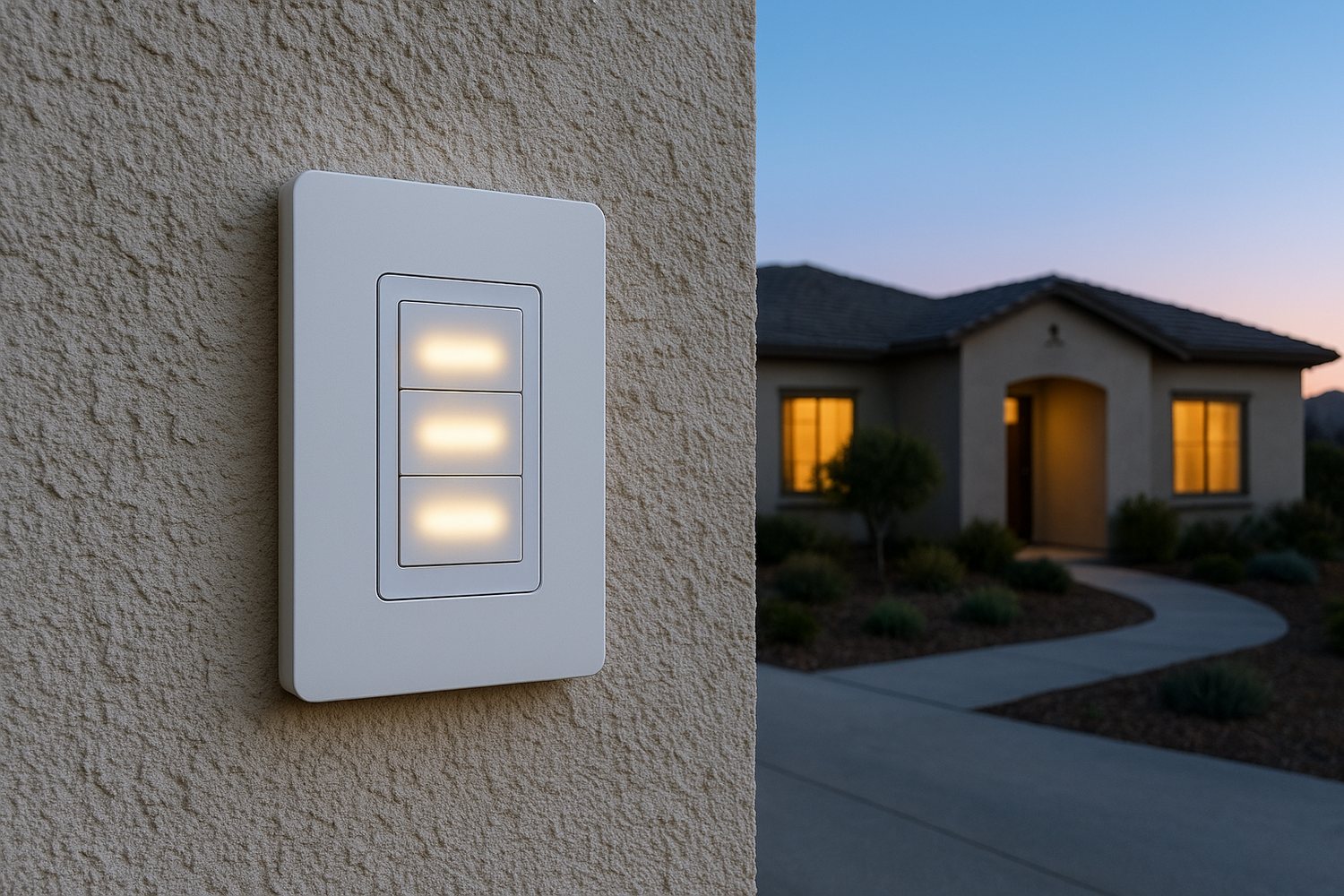
Smart Outdoor Lighting Control Options
Programmable Timers
Basic timers power outdoor lights on and off at pre-set times. Mechanical units offer simple dusk-to-dawn operation, while digital versions help stagger zones or set specific hours for different days. Timers are a straightforward, reliable choice for most homeowners wanting set-and-forget schedules, but lack flexibility if plans change or if daylight hours shift seasonally.
Photocell Sensors
Photocells measure ambient light and turn fixtures on at dusk and off at dawn automatically. They’re ideal for entry paths, security lighting, and landscapes where schedules aren’t as important as responding to natural light. Modern photocells are durable, but can react to shadows or strong reflections, so smart placement matters.
Astronomical Clock Controllers
Astronomical timers use your exact location and a calendar to adjust outdoor lighting based on real sunrise and sunset times. This ensures consistent operation year-round, even as daylight changes. Once set up, these controllers need little maintenance, making them great for busy families or homes with frequent schedule shifts.
Smartphone App Integration
Wi-Fi–enabled lighting controllers connect to your home’s network and smart devices. Using dedicated mobile apps, you can turn lights on and off, adjust brightness, and monitor your system from anywhere. Advanced systems support voice assistants and scene creation. A strong Wi-Fi signal outdoors and good app support are essential for reliability.
Zoning and Dimming
Zoning divides your lighting system into separate groups (patio, path, uplights, pool) for individualized control. Dimming adds more nuance, letting you set the mood or reduce harshness for entertaining. Together, these options allow you to save energy, spotlight key features, and keep light levels flexible as needs change. You’ll need compatible fixtures and controllers.
Scene Programming & Integration
Scenes let you preset groups of lights to specific brightness and color settings for occasions like parties, quiet evenings, or late-night security. Advanced controllers can integrate pool and landscape lighting, so one press dims patio lights, warms up pool colors, and brings out feature trees—all coordinated for the perfect backdrop. Some integrations require professional setup.
How Smart Lighting Controls Are Installed
Smart lighting controls are only as good as their planning and installation. At California Hardscapes, licensed, bonded and insured contractors use a stepwise approach that balances technical installation with durability and safety, ensuring your investment stands the test of time. We only use licensed, bonded, and insured contractors, and every smart lighting project is managed with an eye for detail as if it were our own property.
- Site assessment and subgrade prep: We survey your landscape, identify power sources, mark planned fixture locations, and check soil stability—important for reliable wiring and mounting, especially given our local clay and DG soils.
- Laying base and trenching: For in-ground wiring and control hardware, trenches are cut to proper depth and filled with a stable gravel base to promote drainage and protect cables from settling and shifting soils.
- Setting forms and mounts: Rigid forms and mounting brackets provide level bases for controller housings, conduits, and weatherproof boxes—vital for longevity in areas with irrigation, runoff, and occasional winter freezes.
- Wire reinforcement and safe routing: Wherever wiring crosses driveways, patios, or root zones, we use flexible conduit and approved cable types. We reinforce vulnerable runs and use junction boxes rated for outdoor use.
- Placing electrical junctions, connections, and joints: All splices and joints are made inside sealed, code-compliant housings. We account for future serviceability and make sure controls are accessible but secure.
- Controller installation and fixture finishing: We program timers, photocells, astronomical clocks, or smart hubs as required. All fixtures are tested for function, circuit balance, and app/device compatibility if requested.
- Curing and sealing: Trenches are backfilled and base is compacted, then disturbed hardscape areas are restored and resealed where relevant. Final walkthrough ensures controls work, safety is confirmed, and homeowners get a tutorial.
Pros and Cons of Smart Outdoor Lighting Controls
Strengths
- Convenient, centralized control from switches, apps, or voice assistants; no more running around flipping individual switches outside.
- Automation saves energy by running lights only when needed, and can adapt to changing seasons or daylight hours automatically.
- Improves nighttime safety and security, ensuring important areas—like pathways and entries—are always lit when needed, even if you forget.
- Dimming, zoning, and scene features let you spotlight landscaping or create the perfect mood for entertaining, relaxing, or pool time.
- Future-proofing: Smart systems can integrate with landscape and pool lighting, work with future upgrades, and add curb appeal for resale.
Trade-offs
- Upfront investment is higher than with basic, manual switches; some advanced features require compatible fixtures or new wiring.
- Wi-Fi/app–based systems depend on reliable home networks, which can require troubleshooting or upgrades if you have spotty coverage.
- Some smart apps periodically update interfaces or require new accounts, which may mean ongoing learning or maintenance.
- Integrating multiple brands or legacy lights (especially older pool lights) can require adapters or limit advanced features, adding complexity.
Costs and What Changes the Price
Smart outdoor lighting controls are an investment in convenience, safety, and style—expect to budget more upfront compared to basic setups. At California Hardscapes, we price projects based on the scope of work and materials, the complexity of your landscape, and your choice of control options. We believe in doing every job right, no corners cut, and that means designing systems that last in real-world California conditions. Remember: choosing the cheapest system often leads to frustration and more frequent upgrades or repairs down the line.
- Type and brand of controls: Basic timers and photocells cost less; astronomical timers and smart app systems cost more and may require compatible hardware.
- System size and zones: More zones (patio, paths, pool, garden beds) mean more controllers, wiring, and specialty fixtures.
- Integration complexity: Linking pool lights, patio string lights, or new landscape fixtures into one system adds planning and sometimes extra installation steps.
- Existing wiring and power sources: Homes with limited outdoor electrical infrastructure may need upgrades or dedicated power runs.
- App, Wi-Fi, and smart hub requirements: Expanding your network outdoors or integrating with other smart home devices can add cost if extenders or new hubs are necessary.
- Permitting and inspection needs: Some communities, HOAs, or local codes may require outside lighting review or permit—requirements and costs vary by address and fixture location.
Maintaining Your Smart Outdoor Lighting
Smart lighting controls are built for outdoor durability, but regular checks keep everything running smooth. Inspect fixtures and controllers every season: clear debris from lenses, check for rodent or weather damage to wires, and confirm controls still follow your preferred schedules. Most systems only need basic cleaning and firmware updates (for app-enabled units) once or twice a year. Photocells may need occasional dusting; battery backups, when present, should be tested yearly.
Sealing and corrosion: Where conduits or boxes are exposed to frequent irrigation or hard water, annual inspection or fresh weatherproofing seals can double the life of the setup. Expect 10–15 years lifespan from quality smart controllers with regular care, though moving or changing landscape features may require repositioning or rewiring. Avoid pressure-washing directly on controllers and be cautious during yard maintenance to prevent wire disturbance.
Compare other options

Wall and facade lighting
Learn about wall and facade lighting: options, installation, care and pros/cons for Rocklin area homes. Details on wall washing, grazing, sconces, costs.
Explore →
Step, wall and deck lighting
Step, wall and deck lighting Rocklin homeowners can plan for safety and ambiance: options, build steps and honest guidance.
Explore →
Security and motion lighting
Learn how motion lights and floodlights balance home security and curb appeal. Trusted, honest advice from California Hardscapes in Rocklin, CA.
Explore →Frequently Asked Smart Outdoor Lighting Questions
Is smart outdoor lighting worth it for a typical California yard?
For most homeowners who value both curb appeal and convenience, smart controls are worth the investment—especially if you often entertain or just want your home to look good without hassle. Energy savings, security, and flexible mood setting are big benefits. However, if you rarely use your outdoor spaces at night or prefer absolute simplicity, a basic photocell or manual switch may be sufficient.
Can I control pool and landscape lights together?
Yes—provided your pool and landscape fixtures are compatible or can be tied into the same smart controller. This often means upgrading older pool lights or using adapters, but the payoff is seamless, on-demand ambiance. Scene control lets you instantly set pool, patio, and garden lighting for parties or quiet evenings. Professional integration is recommended for best results and safety.
What happens if my Wi-Fi goes down?
Most quality smart lighting controllers store schedules locally, so your basic timers, astronomical clocks, or photocell functions won’t stop if Wi-Fi drops. However, you’ll lose app and voice control until your network comes back online. Steady Wi-Fi or a network extender outdoors can help ensure reliability, especially for remote adjustments and scene changes.
Are smart lighting controls difficult to use or maintain?
Initial setup and programming are usually handled by the installer. Day-to-day use is often simpler than older manual systems—apps and scene presets put control at your fingertips or on a switch. Some learning is inevitable, especially after a power outage or app update, but most users quickly adjust. Routine care involves occasional cleaning and firmware updates.
Will I need new wiring or can I use my existing lights?
This depends on your current setup and the smart controls you want. Many homes can use existing low-voltage wiring, but older fixtures—especially pool lights or non-dimmable options—may need upgrades to work with advanced controls. Planning out zones and control types with your installer ensures the best performance without unnecessary changes.
How do astronomical clocks differ from regular timers?
Astronomical clocks adjust your lighting schedule based on your geographic location, automatically changing on/off times as daylight hours change through the year. This means you don’t have to reprogram as seasons shift, which is especially useful for year-round curb appeal and safety. Standard timers need manual adjustment or reprogramming with changing sunset times.
Do I need permits or HOA approval for outdoor lighting controls?
Some communities require review or permits for new outdoor lighting, especially if your lighting project involves wiring changes, new electrical runs, or visible fixtures. HOA and city requirements vary by address. It’s always wise to check ahead to avoid issues. At California Hardscapes, we can discuss your plan and help you understand the typical review process.
How long do smart lighting systems last?
Quality outdoor lighting controllers and fixtures should perform for 10–15 years or more with proper installation and regular care. Harsh weather, hard water, and irrigation can shorten life, so plan for seasonal inspections and resealing where needed. As technology evolves, phone apps and firmware may require occasional updates to stay current.
Ready to Explore Smart Lighting?
Email sales@californiahardscapes.com with your address, a brief description of your outdoor area and lighting goals, plus a few photos. We’ll review and be in touch about your best options.