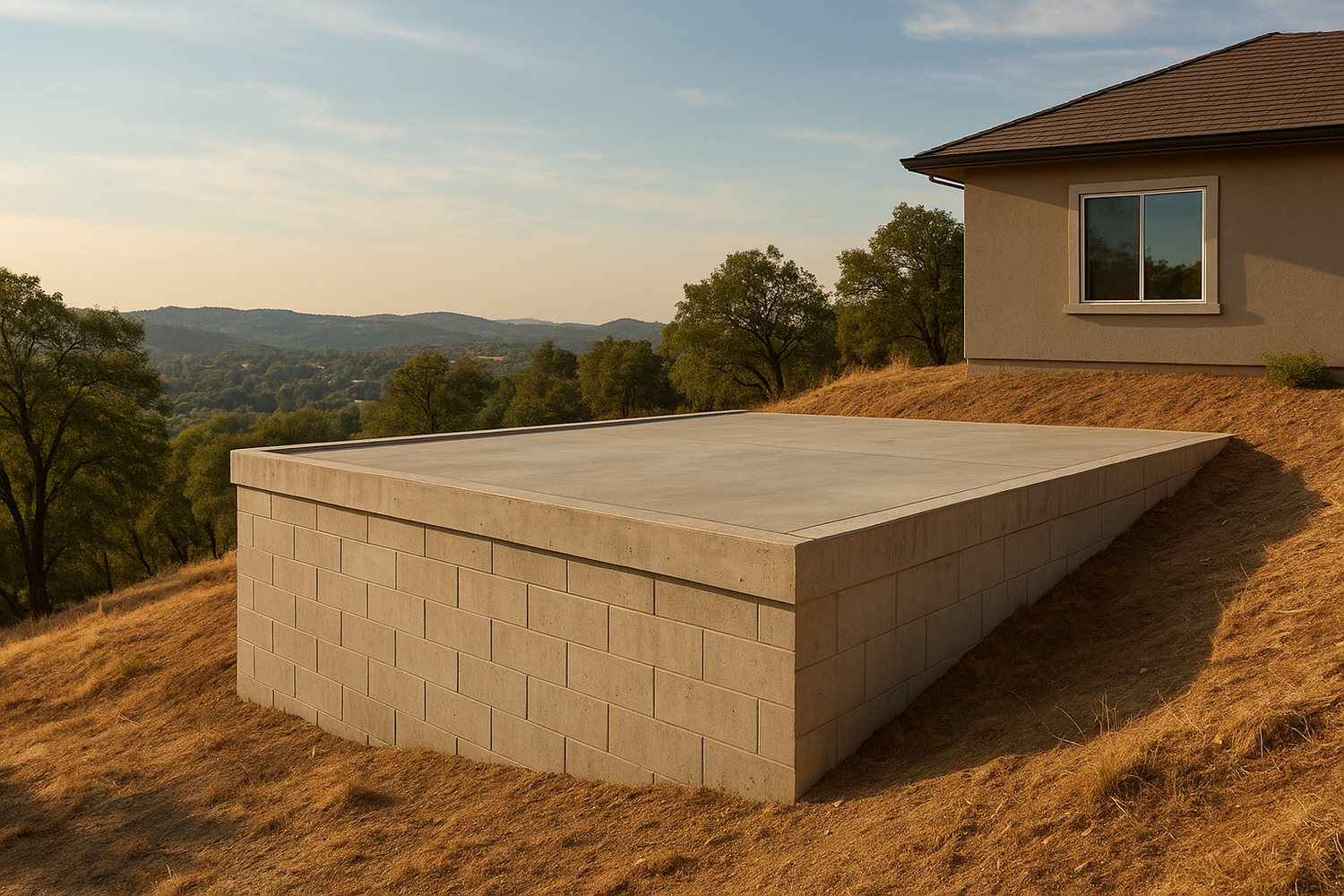
Comparing Block With Geogrid vs Poured Concrete for Tall Retaining Walls
Tall engineered retaining walls have big demands. Here’s how block with geogrid stacks up against poured concrete—region-specific insight for serious homeowners.
Building tall retaining walls means high loads and even higher stakes. Homeowners in our area face soil, slope, and style factors that make material choice a major decision.
The Real Demands of Tall Retaining Walls
When you’re building a wall more than a few feet high in places like Rocklin, Folsom, or Auburn, you’re dealing with serious forces. Tall retaining walls not only support tons of earth but also face drainage challenges and soil expansion, especially during wet winters. The material and design you choose have to be up for the job.
Our local terrain features everything from granite outcroppings to refined suburban slopes. Each creates different pressures and water flow, impacting wall performance. Engineered designs are essential for ensuring stability—anything else risks failure over time.
Whether you want to gain more yard space, control erosion, or create a level platform for outdoor living, the right tall wall can be a permanent solution. So, an informed material choice is vital. Let’s compare the two dominant systems: block with geogrid reinforcement and monolithic poured concrete.
For a full look at structure, design, and engineering, see ourTall and engineered retaining wallsmain page.
What Is Block With Geogrid? Strength From the Ground Up
Segmental retaining wall blocks are designed to lock together, and when paired with layers of geogrid—a high-strength synthetic mesh—they form a reinforced structure. The strength comes not just from the stacked blocks, but from layers of geogrid extending back into the soil behind the wall, distributing loads and tying the mass of earth to the wall system.
This method is widely used for tall residential and even commercial applications in our region. Geogrid allows for flexible design that moves minorly with expanding soils, which is a plus in areas with clay or variable fill. Block and geogrid walls perform well with professional installation and engineered plans.
Homeowners may notice that block walls look refined and come in many colors and finishes. They’re also sometimes easier to repair or adjust in sections, without tearing down the whole wall if there’s an issue.
- Segmental blocks interlock for stability
- Multiple geogrid layers reinforce soil
- Flexible with ground movement
- Attractive finishes available
The Case for Poured Concrete Walls
Monolithic poured concrete forms a single, solid barrier. This option is often chosen for driveways, sharp property boundaries, or when maximum rigidity and space efficiency matter. Steel reinforcement inside increases strength to handle tall heights and heavy slopes, which some local lots demand.
Poured concrete resists erosion and animal burrowing more than many other systems. Its surface is durable and can be finished as smooth, colored, or even with stone facing for a custom look. However, rigid concrete can be more sensitive to soil movement, leading to cracks if drainage or soil prep aren’t perfect.
Installation of poured walls usually involves forms, a solid foundation, and significant prep. Once installed and properly backfilled, these walls offer longevity—but repairs can be more involved compared to segmental systems.
- Maximum rigidity for some wall locations
- Smooth, customizable finishes
- Permanent, but repair can be tricky
| System | Best For | Repairability | Design Flexibility | Common Issues |
|---|---|---|---|---|
| Block with Geogrid | Expansive soils, curved walls, visual options | Sectional repair possible | High (color, texture, layout) | Bulging if not properly drained |
| Poured Concrete | Load-bearing, limited space, modern look | Repairs complex, often needs pro | Medium (color, surface finish) | Cracking if soils shift or drainage fails |
Block With Geogrid vs Poured Concrete: What Really Matters Here
For Placer, Sacramento, and El Dorado County homeowners, climate, soil, and function make the choice interesting. If the wall will take on earth with high water content, expansive soils, or moderate curves, a block with geogrid system provides tested performance and design flexibility.
Where you have extremely tight space, need a true load-bearing wall (like under a driveway), or desire an ultra-sleek look, poured concrete can be a compelling solution—especially on properties where soil movement is minimal. Both options require correct drainage planning and local engineering.
Consider weather, long-term access, and repair potential. Local codes and engineering requirements can influence your choices, so consulting with experienced professionals is always recommended to avoid future headaches.
Local Soil and Site Challenges: What to Watch for in Our Area
Not all tall walls face the same challenges. In Granite Bay, rock outcrops may mean less movement but tough digging, while Roseville and Folsom bring clay soils that expand and shrink. Your wall choice should account for these variations in the immediate area.
Drainage is the number-one reason for retaining wall failures in our area—poorly managed water quickly overpowers both block and concrete. Any tall wall needs robust drainage behind and below, and when engineered correctly, both systems can work in our conditions.
On sloped or cut sites, it’s essential to factor in setbacks and the bearing strength of undisturbed ground. Working with a contractor who understands these local variables can save significant time and expense.
- Clay soils expand and contract seasonally
- Granite sites demand specialized equipment
- Always prioritize drainage solutions
Learn more about all approaches in ourRetaining Wallsoverview and decide what’s best for your landscape.
Aesthetics, Maintenance, and Longevity: Visual and Practical Impact
Block with geogrid walls offer a modular look with many decorative options—perfect for outdoor areas you’ll see and use daily. Color and texture choices are wide, and partial repairs may be easier. Staining or re-capping adds years to their useful life.
Poured concrete achieves a sleek, seamless appearance. It can be color-finished, textured, or faced after construction. Cleaning and sealing extend longevity, but cracks—if they occur—are more complex to address and generally require professional repair.
Either system can last decades when engineered and installed professionally. Regular inspections to address seasonal settling or water issues help prevent larger problems down the line.
- Block: Modular, decorative, easier sectional repairs
- Concrete: Smooth, modern, but repairs can be major
- Both: Last for decades with maintenance
Cost, Access, and Build Time: The Practicalities
The most affordable system often depends on your site’s access and soil. Block with geogrid can be more labor-intensive but uses smaller equipment and less setup, making it fit tricky, tight-access yards. Material costs for both can be similar, but logistics may favor block in built-up neighborhoods.
Poured concrete requires big equipment for forms and concrete delivery. Its faster wall-construction phase is sometimes offset by longer excavation, forming, and cure times before finish work can begin. If schedules and access are tight, discuss these challenges at the start.
Factor in the total project: excavation, drainage systems, permits, and finish treatments. The right builder will help identify all components so you can decide the best system for your exact property.
- Block: Manual labor, less room needed for install
- Concrete: Fast pour, longer prep and cure
- Site access may be the deciding factor
Making an Informed Retaining Wall Decision
Both block with geogrid and poured concrete walls are proven for tall wall projects when designed and installed correctly. The best system for your property comes down to local soil, drainage, use, site access, and visual preference. A one-size-fits-all approach just doesn’t work in our region.
Work with a contractor who seriously evaluates your lot, slope, drainage, and future plans. Ask what drainage, engineering, and finish options are possible for both wall types. Experience and local knowledge often matter more than brand or sales pitch.
If you’re considering a tall retaining wall, start with a real conversation—one that focuses on the site challenges and long-term goals, rather than just cost or appearance. That’s how you get a result that lasts for years and solves your problems for good.
Ready to discuss site-specific retaining wall solutions?Request a consultationfrom Marty and California Hardscapes.
Planning a retaining walls project?
Call or text 916-741-0633, or email sales@californiahardscapes.com with your address, a short description and a few photos, and we will arrange a consultation.